Architecture
How the memory an agent reads and writes is presented as files — the read and write data path, the local cache, memory warmup, and the agent skill AIStor Memory installs. Your storage, your keys; real files, with no model on the write path and no separate database to run.
How the memory is presented as files
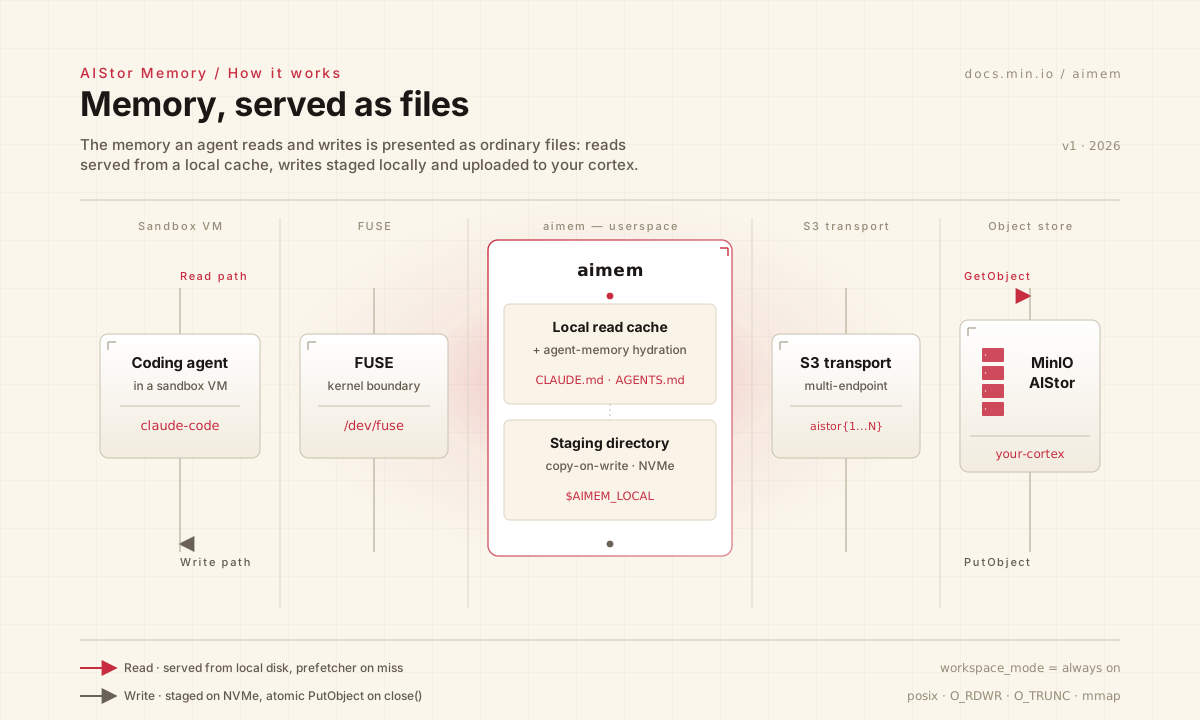
The memory an agent reads and writes — its workspace and its long-term
memory — is presented as ordinary files. (The third form, the vault, is
different by design: secrets are provisioned launcher-side as environment
variables and never written to the mount — see the secrets model.)
AIStor Memory is a single static Rust binary that mounts a filesystem under any
directory you pass it and turns the agent's file operations into calls against a
MinIO AIStor Memory Bucket. A
plain bucket is refused at mount. Reads stream through a prefetcher with
read-ahead; writes are staged on local NVMe and uploaded atomically on
close().
What lands in the Memory Bucket is the bytes themselves — the original file, not a summary rebuilt by a model — in storage you already run, with your own keys. There is no model on the write path, no separate database to run, and nothing to reconstruct on read.
No external services. No metadata cluster. No daemons besides
aimem itself. The rest of this page explains how the mount reaches
that: what ships in the binary, the mount preconditions, and the read and
write data paths.
What ships in the binary
| Capability | What it gives the agent |
|---|---|
| Workspace staging | Every open-for-write is backed by a local copy-on-write file on NVMe, so git, editors, sqlite, and in-place edits all work against it (the syscall-level details are below). |
| Atomic upload | AIStor Memory commits the upload on close() / fsync(): the staged file uploads to S3 in a single shot or a chunked upload, depending on size. The upload is all-or-nothing — the bucket sees either the whole new file or none of it. |
| Local read cache + warmup | The --local store doubles as a read cache. AIStor Memory warms vendor-specific memory paths (CLAUDE.md, .claude/, AGENTS.md, .cursor/, MEMORY.md, …) into it on mount, in the background, so first-touch reads are typically served from local NVMe via FUSE passthrough; a read that arrives before warmup finishes falls back to S3. |
| Read-ahead prefetcher | Sequential-access reads grow a read-ahead window automatically; random-access reads shrink it. Stays out of the way otherwise. |
| Agent skill delivery | The aimem Agent Skill reaches the agent automatically — a read-time preamble prepended to instruction files read from the mount, plus a create-only install into $HOME skill directories — so the model arrives primed on navigation, workspace, memory, metadata, annotations, and search. |
| Multi-endpoint S3 transport | Round-robin across endpoint_url: [http://aistor{1...4}:9000] with optional health-checking and per-request timeouts. |
| Endpoint-provisioned secrets | aimem secret provision runs launcher-side: it resolves the granted secrets and injects them into the agent as environment variables at launch. It resolves them from the Memory Bucket over the Memory-API secrets endpoint (--bucket, the primary path) or, as a bridge, from a generic HTTP store (--store-endpoint / --store-token, e.g. HashiCorp Vault/OpenBao or a cloud manager) when secrets already live there. aimem secret put/get/list/delete <bucket> <name> manage secrets stored in the Memory Bucket over the Memory API. aimem stores no secret bytes itself (pass-through client); the Memory Bucket persists them encrypted server-side. |
| Memory Bucket lifecycle | aimem bucket create / convert / list / get / delete / credentials manage AIStor Memory Buckets launcher-side over the Memory API: create a Memory Bucket (or convert / --upgrade-existing a plain bucket into one), inspect its properties (encryption, compression, KMS key, memory format v1, upgraded flag), and mint STS credentials scoped to a single Memory Bucket. |
| Server-side search | aimem search <bucket> -e <regex> runs RE2 pattern matching entirely server-side over objects at rest — the server decrypts and decompresses server-side, matches in place, and streams matches back; the agent never downloads the workspace. Multiple -e patterns are ANDed (all must match); --ignore-case, --prefix, and --ext narrow the scan. |
| Required staging dir | The local staging directory is required. Supply it in one of three ways: the local: key in --config, the --local <DIR> flag, or the AIMEM_LOCAL env var. CLI/env win when more than one is set, and there is no auto-detection or default. |
Mount preconditions
AIStor Memory mounts only a Memory Bucket — there is no plain-bucket mode. Before the filesystem comes up, the production client verifies four things, each fail-closed with an explicit error:
- An explicit endpoint — the
endpoint_url:config key (or the--endpoint-urlflag). A Memory Bucket mount cannot be verified without one. - Real signing credentials —
AIMEM_ACCESS_KEY/AIMEM_SECRET_KEY(plus optionalAIMEM_SESSION_TOKEN). Anonymous or default-chain mounts are refused because they cannot be verified. - The target is a Memory Bucket, not a plain bucket — AIStor Memory probes the
Memory API
GetCortex; a regular bucket is rejected with a hint to runaimem bucket create. - Paid tier / access — the Memory API is an AIStor Enterprise capability. Access-denied surfaces as "the credentials lack memory:GetCortex, or the server is not on a paid tier."
AIStor Memory does not probe for AIStor-vs-vanilla-S3 at mount (the Server
header is unreliable behind proxies); a non-AIStor backend instead
surfaces a rename error on the first rename().
A mount needs the mandatory version key and a staging dir, supplied here by
the local: key (or by --local / AIMEM_LOCAL). The endpoint can live in
the config too, and the signing credentials come from the environment:
# /etc/aimem/mount.yaml
version: "1.0"
local: /var/cache/aimem
endpoint_url:
  - https://aistor.example.com:9000
export AIMEM_ACCESS_KEY=… AIMEM_SECRET_KEY=…
aimem <bucket> /workspace --config /etc/aimem/mount.yaml--local /var/cache/aimem and AIMEM_LOCAL=/var/cache/aimem are the
flag and env equivalents for the staging dir; supply at least one of the
three (CLI/env win when more than one is set). The endpoint itself is supplied
by the --endpoint-url flag or the endpoint_url: config key (the mount does
not read AIMEM_ENDPOINT_URL — that variable is for the management verbs).
Read path
read(2)
  └─→ FUSE
        ├─→ --local cache hit → FUSE passthrough  (kernel reads the backing fd directly)
        └─→ miss → prefetcher  (advisory read-ahead, sequential growth)
                     └─→ S3 GetObject → written through into --local
The local store (the canonical local: config key; also --local /
AIMEM_LOCAL) is both the write staging area and the read cache. On a
read-mode open, if the object is already in --local
(warmed on mount, or written through by an earlier read), AIStor Memory hands
the kernel the backing file descriptor via FUSE passthrough. Subsequent
reads then bypass the userspace data path entirely. On a miss the
prefetcher streams the object from S3, growing its read-ahead window on
sequential access and shrinking it on random access, and the bytes land
in --local for next time. The agent-memory warmup pass (driven by the
agent YAML key) pre-populates --local on mount in the background —
never blocking the mount — so the bootstrap-read set (CLAUDE.md,
.claude/, AGENTS.md, …) is already local on first touch.
Reading a file while it is being written. A descriptor opened for reading follows the file as it changes. While another descriptor is writing the file, its reads are served from that writer's staged bytes, including a truncate made at open. Once the writer commits, its next read picks up the new object, even if it had already buffered the old one. Three kinds of descriptor keep the bytes they were opened on:
- A descriptor opened while a writer is active reads that writer's staging file, so it does not follow a later, different writer.
- A descriptor whose file was deleted or renamed over keeps reading its own copy of the file it opened, as POSIX requires.
- A descriptor that was given FUSE passthrough is read by the kernel from its
cached copy directly. Passthrough is only granted to read-only opens of
objects already in
--local.
Why this shape. A generic mount either treats every read as cold
against the backend, or caches everything in a separate in-memory or
SSD tier. AIStor Memory keeps a single local store: --local is both the
write-through staging area and the read cache, with warmup priming
exactly the small agent-memory set an agent reads on startup and the
prefetcher handling everything else. One disk store, no second cache
tier to size or operate.
Write path
Workspace mode is always on. Every open-for-write hits the staging
directory — a local copy-on-write file on NVMe — and the staged
file uploads to S3 on close() / fsync().
This is what lets the agent's tools work unchanged:
- Random writes — the file is mutable on the local filesystem.
O_RDWR— same handle reads and writes against the staged file.O_TRUNC— local truncation, plus the upload commits the truncated result.mmap,copy_file_range— returnENOSYS; the kernel falls back to plainread/writeagainst the staged file, so callers still work.- In-place edits with
vim,git, etc. — they see a regular filesystem and never have to learn S3 semantics.
The trade-off: the staging directory needs enough free space for the agent's open-write working set. NVMe is strongly recommended.
Why this shape. Bolting a network filesystem straight onto object
storage — the legacy gateway approach — either rejects random writes
outright or relies on a best-effort upload: a race during close() can
leave the bucket with a half-written object. AIStor Memory's atomic upload
guarantees the bucket only ever sees a complete file — local staging
for a normal-filesystem experience, fenced upload on close().
No metadata cluster
One way to deliver POSIX-correctness on object storage is to externalise the filesystem metadata into a separate database (Redis, Postgres, or a dedicated metadata tier). That's viable for a mount with thousands of concurrent writers, but it adds a whole second system to operate — and agent sandboxes are exactly the wrong place to add operational surface.
AIStor Memory's single-writer-per-mount model gets away without a metadata
cluster entirely. Inodes and directory listings come from S3 itself
(via ListObjectsV2 with delimiter); FUSE caches the metadata for
the duration set by metadata_ttl. There's no separate process to
deploy, monitor, scale, or fail over.
Skill delivery
AIStor Memory ships a first-class Agent Skill named
aimem and delivers it in three tiers, the first two automatic on every
mount — no flags. See the SKILLS section of the aimem
reference for the canonical
description.
- Read-time preamble overlay — instruction files (
CLAUDE.md,AGENTS.md,.cursorrules) read from the mount are served with a short orientation preamble prepended. The injection is in memory only, never written back to the bucket; it is disabled automatically when the mount root is a git repository, and can be turned off withAIMEM_PREAMBLE_OVERLAY=0. - Home-dir install — AIStor Memory installs the
aimemskill into the agent's home skill directories ($HOME/.agents/skills/aimem/for Codex CLI, Cursor, Gemini CLI, Copilot;$HOME/.claude/skills/aimem/for Claude Code, honoringCLAUDE_CONFIG_DIR). The write is offline and create-only, skipped when$HOMEresolves under the mount, and opted out withAIMEM_INSTALL_SKILL=0. - Public repo — agents whose reasoning runs outside the sandbox install
the same skill host-side with
npx skills add minio/skills/aimemfromminio/skills.
Because the memory is a mount of real files, there is something concrete
for the agent to read and somewhere concrete to orient an in-sandbox
agent: AIStor Memory meets the agent where it already looks — the bytes it
reads on startup and the skill directories it already loads. For an agent
running in the sandbox the skill installs automatically, with no separate
integration step (the install is skipped when $HOME resolves under the
mount). An agent whose reasoning runs outside the sandbox adds it host-side
with npx skills add minio/skills/aimem, as above.
Where to read next
aimemreference — full feature surface.- Configuration — YAML key reference.
- Operations — per-sandbox recipes, fstab, logs, metrics.
Operations
Running the memory your agents keep in production — per-sandbox-provider mount recipes, fstab and daemonization, logging, OpenTelemetry metrics, seeding the Vault, and troubleshooting a Memory Bucket mount.
Integrations
How agent sandboxes use AIStor Memory end-to-end — OpenAI Codex / Agents SDK, GitHub Codespaces, Daytona, E2B, Modal VM Sandbox, Vercel Sandbox, Apple container, Kubernetes, OpenShift, OpenSandbox, OpenShell, Devin. What's ready, what's coming, and what's vendor-blocked.